
Emergency Roof Repair Near Me: What Aliso Viejo Homeowners Should Do First
If you’ve got water coming through your ceiling in Aliso Viejo, do three things in this order: contain the water inside, document everything with photos, then call a roofer who can get eyes on the damage the same day. Waiting even 24 hours turns a patch job into a tear-out, and pulling back wet materials yourself can void your insurance claim. If you’d rather skip the guesswork, call us at (844) 717-4930 and we’ll walk you through it.
The most expensive emergency roof damage we see isn’t from the storm itself. It’s from homeowners who waited 48 hours to call, or who climbed up with a flashlight and pulled back damaged shingles trying to figure out what happened, and turned a $900 repair into a $12,000 interior rebuild. Here’s the sequence that protects your home, your claim, and your wallet.
First 15 Minutes: Stop the Water Inside
Before you think about the roof itself, deal with what’s happening inside your Aliso Viejo home. Water moves fast through drywall, insulation, and subfloor, and every minute it spreads adds cost to the repair. The roof is already damaged. Your job right now is to keep the damage footprint from growing.
- Contain the water. Grab the largest container you have, but don’t just set it under the drip. Water splashes, so put a cloth or towel in the bottom of the container to absorb the impact and reduce spray. If water is running down a wall, position the container so the stream lands in it without hitting the wall surface.
- Protect what’s below. Move furniture, electronics, rugs, and anything porous out of the path. If you have a ceiling that’s bulging or sagging, place a tarp or plastic sheeting over the floor below it. A bulging ceiling is a water balloon waiting to burst, and it can release several gallons at once.
- Kill power to affected rooms if water is near any light fixture or outlet. Water and electricity don’t mix. If the leak is coming through a ceiling light fixture, fan, or anywhere near a wall outlet, turn off the breaker to that room. Don’t touch switches with wet hands, and don’t stand in standing water to reach a breaker panel.
This will feel like the least productive part of the process, but it’s actually the highest-value work you’ll do. Most of the cost of a roof leak isn’t in the roof repair. It’s in the ceiling replacement, drywall repair, insulation replacement, and paint. Shrink that footprint and you shrink the bill.
Next 15 Minutes: Document Everything Before You Touch Anything
Insurance adjusters in Aliso Viejo work from evidence, not your memory. Right now, before any repair or even temporary patching happens, take photos and video of everything you can see, both inside and outside if it’s safe to do so from the ground.
Inside, photograph the water stains on the ceiling, any active drips, the floor damage, the walls, and anything that got wet. Pull back the corner of wet carpet if you can, and photograph the water damage underneath. Capture wide shots that show the full room and close-ups that show detail.
Outside, if you can do so safely from the ground, photograph the area of the roof where you suspect the problem originates. Look for missing or lifted shingles, displaced flashing, or debris that may have hit the roof. Use your phone’s zoom before you use a ladder. We’ll say it plainly: do not get on a wet roof. A wet roof is slick even for professionals with proper equipment, and a fall from even a single-story Aliso Viejo home means a hospital visit.
What you’re building is a baseline record. Your adjuster’s first question will be “what did it look like before anything was touched?” If you’ve documented carefully, you have that answer in your camera roll.
When to Call 911 vs. Calling a Roofer
Most roof emergencies in Aliso Viejo are not 911 emergencies. A leak, missing shingles, lifted flashing, or even a small section of roofing material blown loose in a Santa Ana wind event is a roofer call. But there are a few situations where first responders should be your first call, not us.
Call 911 if your roof has been structurally compromised by a fallen tree or large branch, if there’s exposed electrical wiring sparking or arcing anywhere, or if there’s a fire hazard from damaged electrical service where the mast connects to the roof. If the structure is making significant creaking, popping, or shifting sounds and you’re concerned about collapse, evacuate and call 911. We’d rather show up to a house you’re standing safely outside of than read about one in the news.
For everything else, call a licensed roofer. The sooner we can assess, the sooner we can stop the bleeding. A roof that’s actively leaking needs a same-day visit, and in Aliso Viejo, the most important phone call you make today is the one that gets a professional on site before dark.
How to Tarp a Roof Safely (Without Voiding Your Claim)
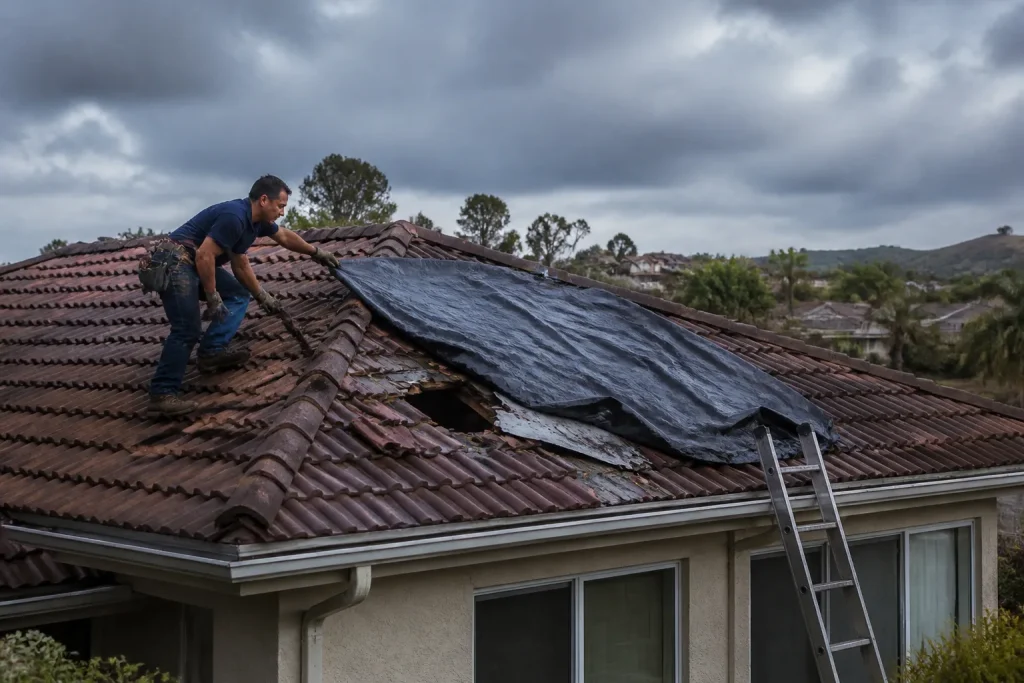
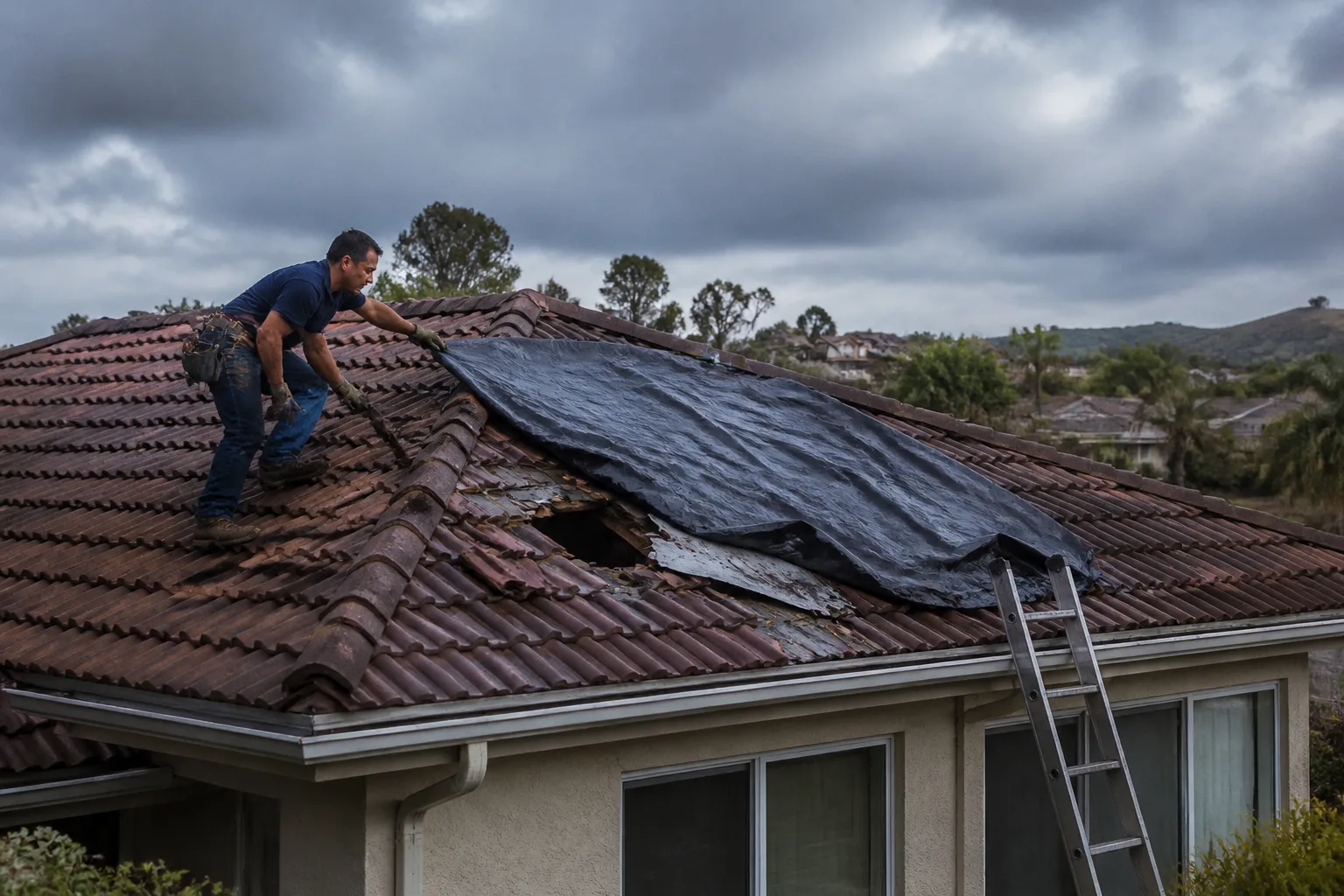
Temporary tarping is the difference between a contained problem and a growing one. But done wrong, it can damage your roof further or complicate your insurance adjustment. Here’s the method we use and recommend.
Materials you’ll need: A heavy-duty tarp (not the thin blue ones from the hardware store general aisle, those shred in wind), 1×3 or 2×4 lumber for anchoring, and roofing nails or screws. Avoid using sandbags or concrete blocks. In Santa Ana wind conditions, those become projectiles and they don’t keep the tarp edges sealed.
The anchoring method that protects the roof: Roll the tarp so it extends at least 4 feet past the damaged area on all sides. Fold the tarp edges around the 1×3 lumber, then nail or screw the lumber into the roof. This creates a sandwich that distributes pressure and won’t tear out when wind gets under the tarp. Never nail directly through an exposed tarp edge without the lumber strip. The wind will shred it from the nail holes outward.
What you should never do: Don’t nail into shingles in a way that creates new holes in non-damaged areas unless it’s absolutely necessary. Don’t use tar or adhesive sealant on damaged roofing materials as a “temporary fix.” Don’t walk on the damaged section. If the slope is steep, if it’s still raining, or if you have any doubt, don’t tarp it yourself. We have the safe access equipment and we’d rather do it right than have you hurt.
One more thing on insurance: a temporary tarp is generally considered reasonable mitigation and won’t void your claim, provided it was applied without causing additional damage. What voiding claims looks like is doing things like removing roofing materials, making permanent repairs before the adjuster sees the original damage, or signing with a storm-chaser who “fixes” things in ways that mask the root cause. We’ve walked onto more than one Aliso Viejo roof where a previous contractor’s temporary repair became the reason a claim was denied.
What to Say (and Not Say) to Your Insurance Company
Your first call to insurance should be quick and calm. You’re not making a claim yet in this first conversation. You’re notifying them of an incident and getting your claim number. Give them the when, where, and what without editorializing.
What to say in the first call: The date and time you noticed the leak or damage, the rooms affected, what you’ve done to mitigate it (tarp, moving furniture, killing power), and that you have photo documentation. Ask for your claim number and the name and contact of the adjuster assigned. Ask what their preferred process is for emergency mitigation so you’re following their path.
What NOT to say: “The roof was old anyway.” “I think it started months ago.” “My neighbor says it’s probably a total loss.” “I’m not sure exactly when it happened.” All of these statements get logged and can be used to reduce coverage or shift blame. Stick to observable facts. The water appeared in the living room ceiling at approximately 2pm on Tuesday. The shingles were intact before the wind event. Keep it to what you saw and when you saw it.
Here’s the thing about adjuster timelines in Aliso Viejo: after a regional weather event, adjusters are stretched thin. You may wait a week or more for a visit. Your roof may not have a week. If the tarp is secure and the interior is contained, you’re probably fine waiting. If the leak is active or the tarp is struggling, you need to make the call on whether to wait or move. This is a conversation your roofer should be part of. We’ve coordinated with adjusters across Orange County, and we can help you make the case for necessary work when the timeline doesn’t match the damage.
Spotting Storm-Chasers vs. Real Aliso Viejo Roofers
After a big Santa Ana event or heavy rain, out-of-state crews show up in Orange County like seagulls at a beach picnic. They knock on doors, they point at your roof, they offer “free inspections” and “insurance claim specialists.” Here’s how to sort the real operators from the chasers.
- They’re going door-to-door with “we were in the area.” Legitimate local roofers in Aliso Viejo don’t need to canvas. We’re already here. A knock on the door after a storm is a sales pipeline, not a service.
- They ask you to sign an Assignment of Benefits (AOB) on the spot. An AOB signs your entire insurance claim over to the contractor. In the wrong hands, it’s a blank check. Real roofers don’t need your claim signed over to do the work.
- They can’t name the neighborhoods. Ask them what part of Aliso Viejo they work in most. If they don’t know Glenwood, Aliso Creek, or the neighborhoods off Alicia Parkway, they don’t work here. We do.
- They’re from out of state, with out-of-state plates on the trucks. Storm chasers chase storms. It’s in the name. They arrive after big weather events and they leave when the easy claims dry up. If your roof has an issue three months later, they’re not coming back because they’re chasing hail in Texas.
- They offer “free roof replacements” or “we’ll pay your deductible.” Both of these are insurance fraud plays. A contractor who offers to waive your deductible is either committing fraud or cutting corners somewhere you’ll find later.
The question to ask is simple: “Would this company exist in Aliso Viejo if there hadn’t been a storm?” If the answer is no, don’t let them near your roof. A legitimate roofer in Aliso Viejo has a local phone number, local references, and a local address. We’ve been doing this in Aliso Viejo since 2017, and we don’t leave when the weather clears.
Santa Ana Wind Damage: What’s Urgent vs. What Can Wait Until Morning
Santa Ana winds are a specific animal. They come down through the passes and hit Aliso Viejo from the northeast, gusting sometimes to 50 or 60 miles per hour. We see the same three damage patterns after every significant Santa Ana event.
Lifted Flashing
Flashing is the metal or synthetic material that seals the joints where your roof meets chimneys, vents, skylights, and walls. Santa Ana winds get under flashing edges and lift them like a crowbar. Flashing that’s lifted even a quarter inch is an active vulnerability. Yes, water is getting in or will be getting in. This is urgent. Call today.
Blown Hip Caps and Ridge Caps
Hip caps and ridge caps are the shingles that run along the peaks and angles of your roof. They take the brunt of wind uplift because they sit at the highest point of the profile. When they blow loose or off, they expose the underlying joints and fasteners to weather. This is also urgent, though slightly less immediately dangerous than flashing failure in heavy rain. The wind itself does the first damage, but the rain that follows is what gets your ceiling wet. Same-day response is warranted.
Displaced Ridge Venting
Ridge vents are the long, thin vents that run along the peak of the roof and let hot air escape from your attic. In Santa Ana conditions, we see them shifted, cracked, or torn loose. A displaced ridge vent is the least urgent of the three. It’s not an active leak risk in the short term unless rain follows the wind event, but it is a signal that wind forces were stronger than the roofline was built for. It should be inspected and reset within a day or two, not ignored for weeks.
Here’s the pattern we’ve learned after years of Santa Ana seasons in Aliso Viejo: the damage that looks dramatic (missing shingles, a torn section of roof) is usually easier to repair than the damage that looks minor but sits at a seam or penetration. Flashing that’s lifted two inches is a bigger problem than three shingles missing in the open field of the roof. If you’re not sure which you have, call us or any qualified roof repair company in Aliso Viejo and describe what you’re seeing. We’ll help you decide if it’s urgent or if it can wait for a morning appointment.
When to Call a Pro (And When You Can Handle It Yourself)
There’s a line between reasonable homeowner response and unnecessary risk. Contain water inside? That’s your job and you should do it immediately. Document damage? That’s also yours. Apply a temporary tarp on a single-story, low-pitch roof in dry conditions? Some Aliso Viejo homeowners are comfortable doing this, and it’s a reasonable DIY task with the right materials. Anything that requires walking on the roof itself, touching damaged materials, or assessing structural integrity? That’s a professional call.
Roof work is some of the most dangerous work in construction. Falls from roofs kill more construction workers every year than any other single cause. A homeowner with a ladder and good intentions is not a substitute for proper fall protection, the right tools, and a trained eye. The cost of a professional assessment is a fraction of the cost of a hospital stay or a botched repair that causes more damage than the original problem.
Related services in Aliso Viejo: If your roof is at the point where repair isn’t the right call, we also handle full roof replacement in Aliso Viejo and can help you sort out whether you’re looking at a patch or a rebuild. If you want a professional assessment of the overall health of your roof before you face another Santa Ana season, our roof inspection service in Aliso Viejo is the place to start. We’ll tell you exactly what your roof needs, and why.
A note on materials while you’re thinking about next steps. If your roof has taken repeated wind damage or you’re looking at replacing sections, material choice matters more than most homeowners realize. We work with seven major roofing brands including GAF, CertainTeed, and Owens Corning, and we don’t push one over another. The right shingle for a South Aliso Viejo home on a ridgeline that catches full Santa Ana wind is different from the right shingle for a home tucked into a canyon. Seven leading brands, one crew that knows them all. It’s not a marketing line. It’s how we keep repair recommendations honest, and it matters when you’re deciding whether to patch or replace.
The Bottom Line
Emergency roof repair in Aliso Viejo comes down to speed, sequence, and judgment. Act fast inside to contain water and cut power. Document before you touch. Call a real local roofer, not a door knocker. Know which damage patterns are urgent and which can wait for daylight. If your roof has taken wind or water damage and you’re not sure what you’re looking at, don’t guess. If you’re in Aliso Viejo and need help, Captain Roof Repair offers free estimates. We take command of the problem so you don’t have to. Call (844) 717-4930.
Check out the Captain Roof Repair home page to see the full range of what we do, or call us directly if you’re looking at a leak right now.
Frequently Asked Questions
Contain the water inside first with a bucket or container, move belongings out of the path, and cut power to the room if water is near any electrical fixture. Then document everything with photos before touching anything, and call a local licensed roofer. Most interior damage from roof leaks comes from delayed response, not the initial leak itself.
Most emergency roof repairs in Aliso Viejo fall between $350 and $900 for a straightforward patch, tarp application, or flashing repair. More extensive damage from fallen limbs or significant structural compromise can run higher. The wildcard is interior damage, which is why acting quickly to contain water is the single biggest money-saving move you can make. Call (844) 717-4930 for an exact quote, and estimates are free.
In most cases, yes, if the damage is from a covered peril like wind, falling trees, or storm. The key is documenting everything before you touch it, mitigating further damage reasonably, and avoiding permanent repairs before the adjuster sees the original damage. We can help you coordinate with your adjuster and make sure the repair process doesn’t compromise your claim.
You can apply a temporary tarp yourself if the roof is low-pitch, conditions are dry, and you use the anchored 1×3 method we described above. But a tarp is a bridge, not a solution. Don’t leave a tarp in place for weeks thinking the problem is solved. Get a professional assessment as soon as practical. Call (844) 717-4930 and we’ll get you on the schedule.
Written by the team at Captain Roof Repair, serving Aliso Viejo since 2017.
Need Roofing Help?
Call Captain Roof Repair — licensed & insured, here with fast after-hours help in Aliso Viejo.
(844) 717-4930